Architecture
PseudoPath combines a NER model, fixed rules, and a trained line router. The router selects which lines the model processes, while the rules inspect the full document. This page describes the components and the training and prediction workflows. See the API reference for method signatures.
Workflow overview
The following diagram shows training, configuration, and inference. Open it to inspect the steps at full size.
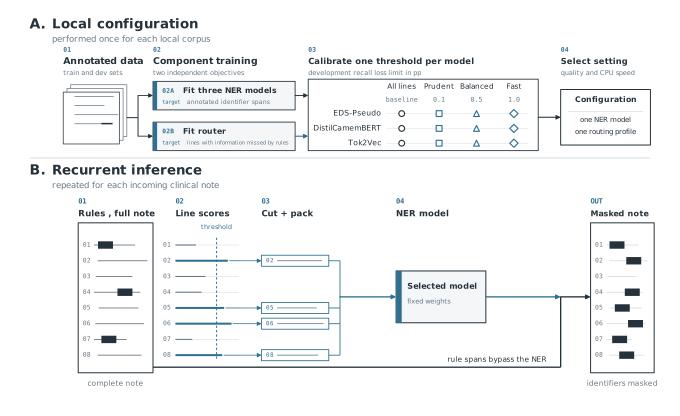
PseudoPath workflow. A: adapt candidate models, train the residual-line router, calibrate profiles, and select a configuration. B: apply rules to the full document, route and pack selected lines for the chosen model, project predictions back, and combine them with rule entities.
In the package, fit configures one model at a time. Comparing the three
models shown in the diagram means fitting separate instances. See
models and configuration to select each starting model.
The figure shows the complete masking workflow. predict returns spaCy
entity spans. The calling application applies masking or replacement to
produce the illustrated masked note.
Component responsibilities
Component |
Responsibility |
|---|---|
|
Hold the working model, router, and calibrated profiles. Coordinate training, prediction, and persistence. |
NER model |
Learn entities and predict them using its own model library. |
|
Translate between the model library and PseudoPath’s training, prediction, and saving operations. |
Fixed rules |
Find entities from built-in patterns and optional patient context, independently of the model backend. |
Line router |
Score physical lines so the neural model can process only a selected part of a document. |
Calibration |
Choose profile thresholds from validation predictions and recall constraints. |
Built-in training settings |
Hold learning parameters as immutable values, separate from model architecture. |
Presets construct a model and select its adapter. To use a custom model,
create or load it with its own library, then pass it to PseudoPath with
an adapter implementing NERAdapter.
Training flow
One fit coordinates three dependent steps:
Train the neural model and select its validation checkpoint.
Apply fixed rules to the annotated corpus, then train the router to distinguish lines containing target entities the rules missed from lines without them.
Calibrate router thresholds against validation predictions, using all-lines prediction as the reference for character-recall loss.
The selected model, trained router, and calibrated profiles form one fitted instance. See training and routing for data requirements, successive phases, and recall budgets.
Prediction flow
Fixed rules inspect the whole document. In routed modes, the router selects lines for the neural model, which receives their packed text. All-lines mode sends the whole document instead. Model offsets are projected back to the source document. Predictions crossing inserted separators are discarded. The package merges model and rule entities, resolves overlaps, and returns source-linked spaCy spans.
Prediction preserves the input document’s annotations and patient context.
Returned spans refer to the source document and can be assigned to doc.ents
by the caller. Their boundaries must align with the source tokens.
Model integration boundary
An adapter implements training, prediction, and saving for its model library. Restoring a custom artifact also requires a model loader. See custom models for the contract.
PseudoPath uses spaCy documents and spans. Adapters return entity predictions as character offsets, which PseudoPath converts to spans on the source document.
Configuration and saved state
Choose the model architecture at construction and supply learning settings to
fit. See models and configuration for available controls.
Save the fitted model, router, profiles, and metadata with to_disk, then
restore them for prediction or further fitting. See
save and restore for the artifact contract and
reproducibility for experiment records.