How it works
This page explains how IAML turns a pipeline definition into evaluated and fitted results, and how its core classes divide that work. For training settings, start with 01 / Build; for component implementation, see Extending IAML.
Recipes and fitted pipelines
A recipe describes permitted pipeline structures and parameter domains;
a candidate is one concrete pipeline evaluated during the search.
At the start of fit, IAML copies and resolves the recipe into execution
steps. Each run therefore has its own search scope and analytical definitions.
Editing a recipe later does not change its previously fitted candidates.
The built-in recipe combines a full main strategy and a minimal strategy
for predictors needing little preparation. A custom recipe defines its own
branches. Both entry points use the same execution engine described below;
Build and adapt a pipeline covers recipe construction and editing.
From data to a fitted pipeline
Generate candidates. IAML selects components whose tags and suitability checks match the data. It explores combinations of cleaning, feature selection, normalization, resampling and prediction steps. The default genetic search starts with a limited set of preprocessing choices and explores alternatives during optimization.
Evaluate candidates. Each pipeline is fitted and evaluated with cross-validation. Each fold learns preparation and model state from its training observations. The main metric determines candidate ranking.
Optimize candidates. The default genetic optimizer changes pipeline components and parameters, retaining promising candidates for further evaluation. Search continues until the time budget, patience limit or optimizer stopping condition is reached.
Refit the selected pipelines. IAML fits the best candidates on the training data and returns them in ranked order. The first returned candidate is also available as
chosen_candidate.
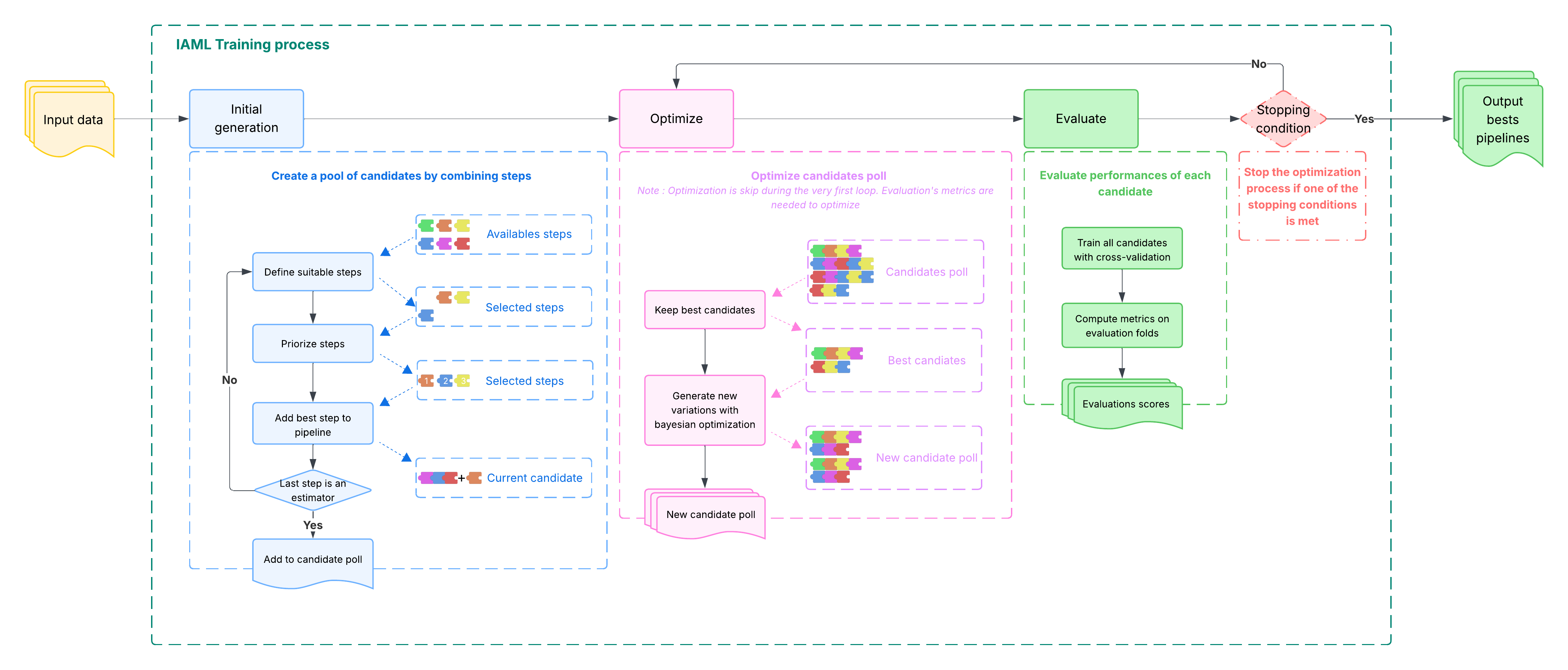
Training loop illustrated with Bayesian optimization. The default search uses genetic mutations. Click to enlarge.
Choose the validation strategy and main metric for the study before starting the search. Cross-validation scores guide model selection. Use a separate evaluation dataset to assess the selected pipeline. See 01 / Build for validation, sampling, refitting and time-budget settings, and 02 / Evaluate for interpreting scores and assessing held-out data.
Components and extensions
Most studies interact with IAML and the selected Candidate. The classes
below explain how data, pipeline construction and evaluation fit together.
Follow a class name for its API reference.
The search and its results
Class |
Role |
|---|---|
Coordinates candidate generation, validation, optimization and final
fitting. Holds the search settings and exposes the selected candidate
through |
|
|
Describe the pipeline’s structure and search scope, along with metric, statistic and explanation collections. Compilation creates fresh execution instances for each run. |
Carries features, targets, optional groups and detected data types. Steps use this information to check applicability. Splitting and sampling keep features, targets and groups together. |
|
Combines a pipeline with its dataset, metrics and validation results. Provides prediction, held-out evaluation, pipeline descriptions, explanations and method references. |
|
Holds the ordered transformations, training-only resamplers and final predictor. Reuses fitted transformations when predicting new observations, without resampling them. |
After fitting, search.chosen_candidate gives access to the results and
reporting methods. Its pipeline attribute contains the fitted
IAMLPipeline, also exposed as search.chosen_model.
Steps and their organization
Step defines the shared contract for suitability,
configuration, tags and method references.
Actionable is the base for concrete transformations,
resampling operations and predictors.
Predictor specializes it to wrap a learning model
and expose its prediction methods. Probability and survival outputs depend
on the wrapped estimator’s capabilities.
Tags associate registered steps with search stages. Compiled meta steps control whether a stage executes components in order, selects them adaptively or branches into alternatives.
Evaluation, optimization and reporting
Metricdefines how predictions are scored, which prediction method is needed and whether larger or smaller values are preferable. The main metric controls candidate ranking.Optimizerproposes the next pool from evaluated candidates. Genetic optimization can change steps and parameters. Bayesian optimization tunes parameters within an existing pipeline structure.Statisticcomputes descriptive summaries of the dataset, such as missing-value counts or feature distributions.Plotprovides the common interface for figures and their export. Specialized classes cover descriptive plots, model performance and SHAP views.
Validation splitters are callables. They receive a Dataset and yield pairs
of training and validation Dataset objects, allowing study-specific split
strategies without a new base class.
See Extending IAML for examples of implementing and connecting these extensions, 03 / Explain and Study reporting for using their outputs, and Component availability to browse component families and their API.